



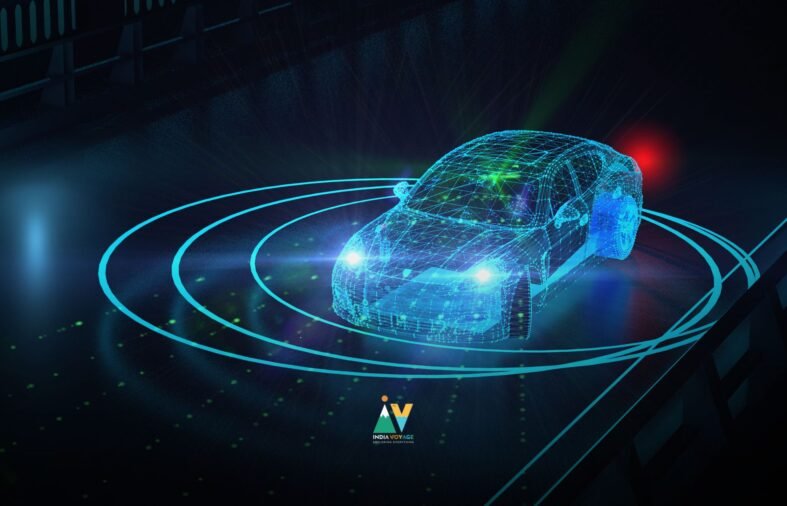

The idea of a car that can drive itself once belonged to science fiction. Today, full self-driving (FSD) vehicles are no longer just conceptual experiments but real machines navigating city streets, highways, and complex traffic scenarios. They represent one of the most ambitious technological pursuits of the modern era—bringing together artificial intelligence, robotics, data science, and real-time decision-making. Yet, while this technology has made remarkable progress in structured environments, its true test lies in places where order gives way to unpredictability. Few environments challenge autonomy more than Indian roads.
How Full Self-Driving Cars Work
At the heart of a full self-driving car is an artificial intelligence system designed to replicate—and in some cases outperform—human driving abilities. These vehicles rely on a combination of sensors, computing power, and software intelligence to understand and interact with the world around them.
Multiple sensors continuously scan the environment. Cameras capture visual information such as lane markings, traffic lights, pedestrians, and vehicles. Radar measures distance and speed of nearby objects, especially useful in low-visibility conditions. In some systems, lidar uses laser pulses to create a precise three-dimensional map of the surroundings. This sensor data is fused together to create a real-time, high-resolution understanding of the road.
Once the environment is perceived, machine learning models take over. These models are trained on millions of kilometres of driving data, allowing the car to recognize patterns—such as when a pedestrian is about to cross or when another vehicle may change lanes. The system then predicts possible outcomes and decides the safest and most efficient course of action. All of this happens in milliseconds, guided by powerful onboard computers capable of processing enormous amounts of data instantly.
In essence, a self-driving car sees, thinks, and acts—constantly learning from past experiences to improve future decisions.
Why Full Self-Driving Is Considered the Epitome of Technology
Full self-driving technology stands at the intersection of several advanced fields. It is not a single innovation but a convergence of breakthroughs that collectively push the limits of what machines can do.
First, it represents one of the most complex real-world applications of artificial intelligence. Unlike controlled environments such as factories or labs, driving requires operating in open, unpredictable spaces filled with human behavior. Teaching a machine to handle this uncertainty is a monumental challenge.
Second, FSD systems demand real-time intelligence. Decisions must be made instantly, often with life-or-death consequences. This requires not only accurate perception but also ethical and safety-driven prioritization—something machines were never originally designed to handle.
Third, full self-driving cars rely heavily on data at an unprecedented scale. Every autonomous vehicle contributes to a feedback loop where real-world driving improves the system for all vehicles using the same platform. This collective learning model reflects how modern technology evolves—through networks, not individuals.
Because of this complexity, success in full self-driving is often seen as proof that a company or a society has mastered cutting-edge AI, computing, and systems engineering. It is not just about mobility; it is about demonstrating technological maturity.
The Gap Between Controlled Roads and Real-World Chaos
Despite these advancements, full self-driving systems perform best in environments that are structured and predictable. Well-marked lanes, disciplined traffic, consistent signage, and rule-following behavior create conditions where algorithms thrive.
However, the real world is rarely perfect. Human drivers frequently rely on intuition, eye contact, and social negotiation—elements that are difficult to quantify or encode into software. This gap between algorithmic precision and human adaptability becomes increasingly visible as road conditions grow more complex.
Why India Is the Toughest Test Case for Full Self-Driving
If full self-driving cars are ever to be considered truly autonomous, they must succeed in India.
Indian roads operate on a logic that is fundamentally different from the environments where most self-driving systems are trained. Traffic is highly mixed, with cars, buses, two-wheelers, auto-rickshaws, pedestrians, animals, and handcarts sharing the same space. Lane discipline is fluid, road markings are inconsistent, and traffic signals are often interpreted rather than strictly followed.
Driving in India is less about rigid rules and more about constant negotiation. A human driver reads subtle cues—body language of pedestrians, intent of another driver inching forward, or the unwritten understanding of who will yield. These decisions are deeply contextual and culturally ingrained, making them extraordinarily difficult for artificial intelligence to replicate.
Infrastructure variability adds another layer of complexity. Roads can change abruptly, construction zones may lack clear warnings, and unexpected obstacles are common. Weather, dust, and pollution further challenge sensor reliability, especially for camera-based systems.
Beyond technology, regulatory and legal frameworks in India are still evolving. Questions around liability, accountability, and safety standards for autonomous vehicles remain largely unanswered, making large-scale deployment even more challenging.
Conclusion: The Real Measure of Autonomy
Full self-driving cars are undeniably one of the greatest technological achievements of our time. They showcase how far artificial intelligence, data processing, and engineering have advanced. In controlled environments, they already demonstrate impressive capabilities and hint at a future where transportation may be safer and more efficient.
However, true autonomy is not proven on perfect roads. It is proven in complexity.
India, with its dynamic traffic, human-driven chaos, and infrastructure contrasts, represents the ultimate benchmark for self-driving technology. If autonomous vehicles can navigate Indian roads safely and reliably, they will not just be technologically advanced—they will be truly intelligent.
Until then, India remains the world’s toughest classroom for teaching machines how humans really drive.
Leave A Reply