



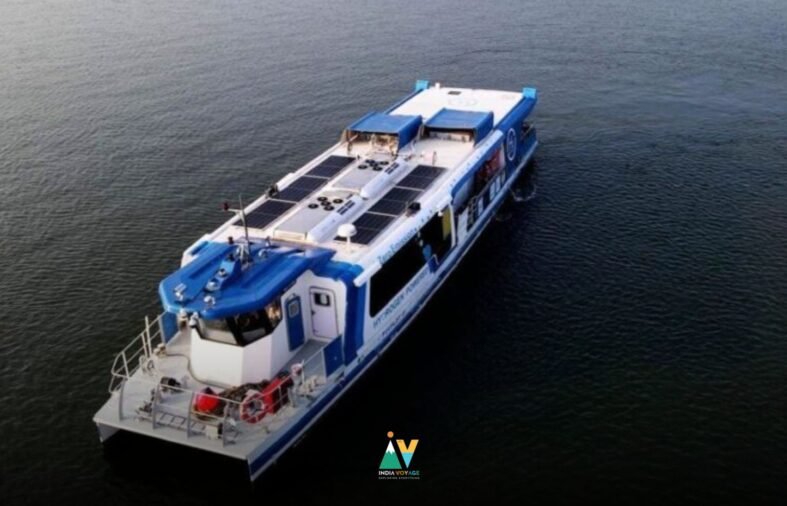

India has taken a landmark step toward sustainable inland transport with the launch of its first fully indigenous hydrogen fuel cell passenger vessel, which has now begun commercial operations on the river Ganga in Varanasi. Flagged off by Union Minister for Ports, Shipping and Waterways Shri Sarbananda Sonowal at Namo Ghat, the vessel represents a significant leap in the country’s journey toward clean energy, self-reliance, and net-zero waterways
What Is the Purpose of This Hydrogen Fuel Cell Vessel? Explained Simply
In simple terms, the purpose of this hydrogen fuel cell vessel is to offer clean, quiet, and efficient public transport on water, especially in busy and culturally significant cities like Varanasi.
Think of it like the difference between a diesel bus and an electric bus on the road. Traditional passenger boats usually run on diesel, which means engine noise, smoke, fuel smell, and pollution released directly into the air and water. Over time, this affects not just the environment but also the health of people living near the river and those who travel daily.
This hydrogen-powered vessel works very differently. Instead of burning fuel, it converts hydrogen into electricity, which then powers the boat. The only thing that comes out of the system is water. No smoke, no fumes, and no loud engine noise. For passengers, it feels like a smooth, silent ride—almost like gliding over the river.
For example, a pilgrim traveling from Namo Ghat to Lalita Ghat would normally experience engine vibrations and noise on a conventional boat. On this vessel, the same journey becomes calmer and more comfortable, with clean air and no disturbance to the river’s surroundings. This is especially important on the Ganga, where environmental protection and spiritual significance go hand in hand.
Compared to existing diesel-powered vessels, the hydrogen fuel cell catamaran is:
- Zero-emission, releasing only water instead of pollutants
- Noise-free, improving comfort for passengers and reducing disturbance to river life
- More energy-efficient, using a hybrid system of hydrogen, batteries, and solar power
- Better for cities, as it helps reduce road traffic by encouraging water-based commuting
- Future-ready, aligning with India’s long-term goal of sustainable and green transportation
In essence, this vessel is not just a new boat—it is a proof of concept. It shows how India can move people efficiently on rivers without harming the environment, setting the stage for cleaner waterways, healthier cities, and a smarter transport system for the future.
Owned by the Inland Waterways Authority of India (IWAI) and constructed by Cochin Shipyard Limited (CSL), the vessel has entered commercial service after successful trial operations. Its rollout aligns with India’s long-term commitment to achieving net-zero carbon emissions by 2070 and reflects the government’s broader push to introduce green and alternative fuels across the inland waterways sector.
Speaking at the launch, Shri Sarbananda Sonowal highlighted that the vessel is a strong example of the “Make in India” vision under the leadership of Prime Minister Narendra Modi. He emphasized that clean and sustainable transport solutions are central to India’s development model, where economic growth and ecological responsibility move together. The introduction of hydrogen-powered mobility on the Ganga also supports the mission to rejuvenate and preserve the river, while modernising urban transport systems.
Designed specifically for urban water transit, the catamaran can carry up to 50 passengers in a fully air-conditioned cabin and operates at an average service speed of around 6.5 knots. Its hybrid energy architecture integrates hydrogen fuel cells, battery storage, and solar power, enabling up to eight hours of continuous operation on a single hydrogen fill. Certified by the Indian Register of Shipping, the vessel meets stringent safety and operational standards.
To operationalise the pilot project, IWAI, Cochin Shipyard Limited, and Inland and Coastal Shipping Limited have entered into a tripartite agreement. This framework outlines technical support, operational responsibilities, safety protocols, monitoring systems, and periodic inspections during the pilot phase, ensuring safe and reliable deployment of this new technology.
Beyond its technological significance, the hydrogen fuel cell vessel offers multiple benefits for Varanasi’s urban mobility. Passengers experience quiet, vibration-free travel, while the city benefits from reduced air pollution and lower road congestion as more commuters shift to waterways. The initiative is also expected to enhance tourism, generate local employment, and place Varanasi among a select group of global cities adopting hydrogen-powered public transport.
The maiden commercial run covered a five-kilometre stretch from Namo Ghat to Lalita Ghat and was attended by senior Union and state ministers, elected representatives, and top officials from the Ministry of Ports, Shipping and Waterways, IWAI, and the Government of Uttar Pradesh. Their presence underlined the national importance of the project and its role in shaping the future of inland water transport in India.
Following the earlier introduction of hybrid electric catamarans, the deployment of this hydrogen fuel cell vessel strengthens IWAI’s long-term roadmap to modernise and decarbonise National Waterways. Guided by the Maritime India Vision 2030 and the Maritime Amrit Kaal Vision 2047, the project marks a decisive move toward a cleaner, energy-efficient, and globally competitive maritime ecosystem—powered by innovation, sustainability, and indigenous capability.
Leave A Reply